


Thorny Devil: How It Survives the Desert and Where to See One at Uluru
TL;DR: The thorny devil (Moloch horridus) is a small, spiky desert lizard that grows to less than 20 cm long. Aṉangu call it ngiyaṟi. It eats only ants, sometimes thousands in a day, and has narrow grooves between its scales that channel water towards its mouth. It lives across arid Australia, including Uluṟu-Kata Tjuṯa National Park, where it can sometimes be spotted crossing roads or moving through sandy country.
The group is halfway along the track when someone stops and points at the sand. For a few seconds, nobody can see a thing. Then it moves. A lizard smaller than your forearm, covered head to tail in spikes, rocking slowly forward like a wind-up toy.
That’s a thorny devil. They’re brilliantly camouflaged and surprisingly easy to miss, but spotting one in the Red Centre is a pretty special moment. Here’s how this odd little lizard survives the desert, and where to keep your eyes peeled around Uluṟu.
What Is a Thorny Devil?
The thorny devil is a small Australian dragon lizard, related to bearded dragons and frill-necked lizards. Its scientific name is Moloch horridus, while its Pitjantjatjara and Yankunytjatjara name is ngiyaṟi.
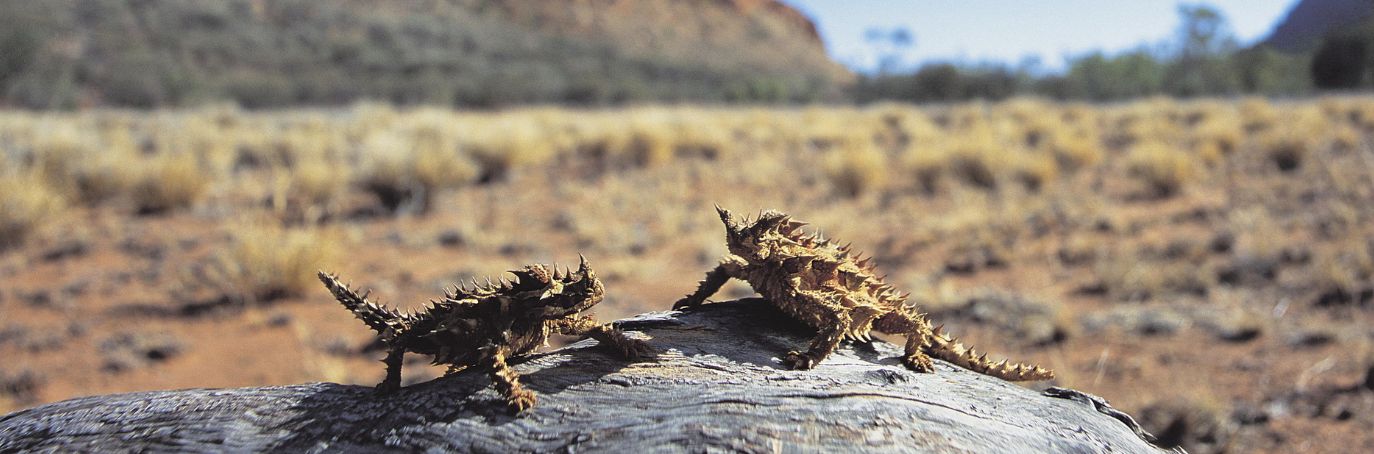
It grows to less than 20 cm long and is covered in densely packed spikes. Its colouring can range from yellow and orange to brown and white, helping it blend into the desert around it. Parks Australia says thorny devils become darker when it’s cold or when they’re alarmed.
Those spikes aren’t just there to make it look intimidating. They help protect the thorny devil from predators, along with another clever trick: a knob-like structure behind its head that looks like a second head.
How Does the Thorny Devil Survive the Desert?
The Red Centre throws scorching days, cold nights and long dry spells at its wildlife. The thorny devil has a few clever adaptations for dealing with all three.
How does a thorny devil drink?
This is the thorny devil’s best party trick. Narrow grooves between its scales form a network across its body. When the lizard stands in wet sand or water, capillary action draws moisture along these grooves towards its mouth.
That means it doesn’t need to find a puddle deep enough to drink from. Moisture on wet sand or other surfaces can be channelled towards its mouth through this unusual skin system.
What do thorny devils eat?
Ants. That’s basically the entire menu.
A thorny devil parks itself beside an ant trail and catches the insects with its sticky tongue. Parks Australia says a single thorny devil can eat thousands of ants in a day.
Not bad for a lizard that’s less than 20 cm long.
What is the false head?
Look closely at a thorny devil and you’ll notice a spiky lump behind its real head. It looks like a second head, and that’s exactly the idea.
When threatened, the lizard can tuck its real head down between its front legs, leaving the false head exposed. It can also puff itself up to look larger. Both tricks make it a less appealing target for predators.
Can thorny devils change colour?
Yes. Thorny devils are paler in warm weather and become darker when it’s cold or when they’re alarmed.
That darker colour can also help them absorb more solar heat when they’re warming up in cooler conditions.
Why do thorny devils walk so strangely?
They have a distinctive slow, rocking walk, stopping and starting as they move. Parks Australia says this behaviour is thought to confuse birds of prey.
It looks a little odd, but against the desert background, that stop-start movement may make the thorny devil harder for predators to track.
Where Do Thorny Devils Live?
Thorny devils live across much of arid and semi-arid Australia. They occur across several states and territories, including the Northern Territory, Western Australia, South Australia and Queensland.
Uluṟu-Kata Tjuṯa National Park is part of their range, with thorny devils living among the park’s sand, spinifex and other desert habitats. Parks Australia lists ngiyari among the reptiles found in the park.
They’re active during the day and have adaptations that help them cope with the big temperature swings of Central Australia.
Where Can You See a Thorny Devil at Uluru?
This is where patience helps. Thorny devils are small, well camouflaged and easy to miss.
Roads around Uluṟu are a known place to encounter them. Research into ngiyari at Uluṟu began partly because local students noticed how often the lizards appeared on roads between Mutitjulu and Yulara. Researchers are still investigating why they use roads, including whether the surfaces help with thermoregulation or whether the lizards are simply crossing them.
You can also keep an eye out when walking through the park:
- Look down at the ground rather than just at the scenery
- Watch sandy areas and the edges of spinifex
- Take your time, especially where the ground is open and visibility is good
- If you’re driving, keep an eye out on the road and slow down when conditions allow
You may spot one moving across the road, but there’s no guaranteed place or time to find them. That’s part of the fun.
If you do see one, give it plenty of space and let it continue on its way.
How Do You Watch One Without Disturbing It?
If you see a thorny devil, lucky you. Enjoy it from where you’re standing.
Don’t touch, pick up or move it, even for a photo. Parks Australia asks visitors not to touch or handle wildlife in the national park.
Stay on marked tracks and give the lizard plenty of room. If it’s crossing a road, don’t stop somewhere unsafe just to get a closer look.
A zoom lens is your friend. Your hands can stay firmly to yourself.
What Other Reptiles Live Around Uluru?
The thorny devil has plenty of scaly company. The perentie, Australia’s largest lizard, can grow to around 2.5 metres. You’ll also find sand goannas, bearded dragons, skinks, geckos and several snake species around the park.
Our post on native outback wildlife introduces more of the locals.
Before You Go
You can’t book a thorny devil sighting, but you can give yourself a better chance by slowing down and keeping your eyes on the ground. Early morning and late afternoon are also sensible times for exploring Uluṟu in warmer months, when Parks Australia recommends planning activities for the cooler parts of the day.
If you’d like a guide by your side, our 3 Day Uluru and Kings Canyon tour includes walks at Kata Tjuṯa, around the base of Uluṟu and along the Kings Canyon Rim. Keep your eyes peeled and you might get lucky.
Frequently Asked Questions
Where do thorny devils live?
Thorny devils live across arid and semi-arid parts of Australia, including the Northern Territory, Western Australia, South Australia and Queensland. Uluṟu-Kata Tjuṯa National Park is within their range.
Can you see thorny devils at Uluru?
Yes. Thorny devils live in Uluṟu-Kata Tjuṯa National Park, although they’re small and well camouflaged. Road sightings around Uluṟu are known to occur, and you may also spot one while walking through sandy desert country.
What do thorny devils eat?
Ants, almost exclusively. Parks Australia says a single thorny devil can eat thousands of ants in a day.
How does a thorny devil drink water?
Narrow grooves between its scales form a network that channels water towards its mouth through capillary action. It can collect moisture from wet sand or standing water this way.
Are thorny devils dangerous?
No. Thorny devils aren’t venomous and generally avoid people. Their spikes, false head and ability to puff themselves up are defensive adaptations that help protect them from predators.
Can you touch a thorny devil?
No. Don’t touch, pick up or move one. Parks Australia asks visitors not to touch or handle wildlife in Uluṟu-Kata Tjuṯa National Park.
Other Tips & Articles

Check out our other Uluru Tours


